
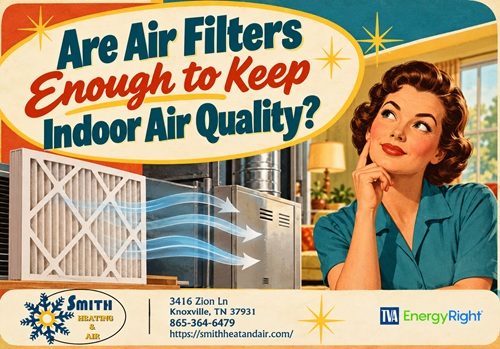
Air filters are an important part of keeping your Knoxville home comfortable, but they are only one part of the indoor air quality picture. Effective HVAC air filtration depends on the right filter, proper installation, good airflow, clean equipment, controlled humidity, and an HVAC system that is working as intended.
In fact, simply replacing a dirty filter may not address buildup on coils, blower components, drain areas, or other parts of the system. Smith Heating and Air can inspect the entire HVAC system to identify conditions that may affect airflow, cleanliness, comfort, and indoor air quality.
How Does HVAC Air Filtration Work?
As your HVAC system circulates air through your home, the air passes through a filter before moving through the equipment and back into your living spaces. The filter is designed to capture certain airborne particles.
However, filters vary considerably in their ability to capture particles. Filter efficiency is commonly measured using a MERV rating. In general, a higher MERV rating indicates that the filter can capture smaller particles.
That does not mean the highest-rated filter is automatically the best choice for every HVAC system. A filter that is too restrictive may reduce airflow if the equipment was not designed for it.
The filter must also fit correctly. Gaps around an improperly sized filter can allow air to move around the filter rather than through it.
Why Does Proper Airflow Matter?
Your HVAC system needs adequate airflow to heat and cool your home effectively. Dirty filters, blocked vents, dirty equipment, duct restrictions, and other problems can interfere with that airflow.
When airflow is restricted, the system may have to work harder to maintain the thermostat setting. Homeowners may also notice uneven temperatures, weak airflow from registers, longer operating cycles, or rooms that never seem as comfortable as the rest of the house.
This is why HVAC air filtration should be considered as part of the entire system rather than as a stand-alone solution.
What Can Build Up Inside an HVAC System?
Dust and debris can accumulate on internal HVAC components over time. Depending on conditions inside the system, technicians may find buildup around coils, blower components, cabinets, drain areas, and other surfaces.
Moisture can make these conditions more concerning. Cooling equipment naturally produces condensation, so drain pans and condensate lines need to function properly.
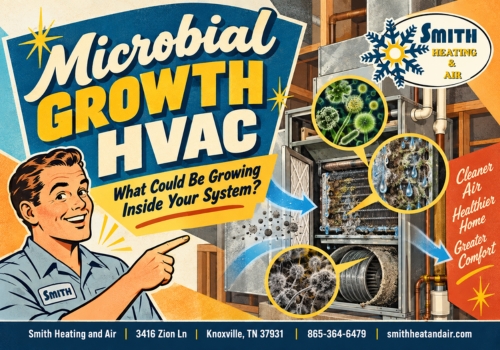
Dust combined with moisture can create conditions that support unwanted microbial growth. Therefore, professional HVAC system cleaning and maintenance may involve more than replacing an air filter. A technician can inspect accessible components and determine whether cleaning, maintenance, drainage correction, or another service is appropriate.
How Do Coils and Blower Components Affect Indoor Air Quality?
 The evaporator coil and blower are directly involved in moving conditioned air through the HVAC system.
When these components become dirty, the problem can affect both system performance and cleanliness. A dirty blower wheel, for example, may not move air as efficiently as a clean one. Buildup on coils can also interfere with normal heat transfer.
Keeping these areas properly maintained helps the HVAC system operate as designed while addressing sources of dirt and buildup inside the equipment.
What Role Does Humidity Play?
Humidity is another major part of indoor air quality.
High indoor humidity can make a home feel uncomfortable and may contribute to conditions that allow microbial growth in damp areas. On the other hand, extremely dry air can also create comfort concerns.
Your HVAC system plays an important role in moisture management. However, equipment sizing, operating cycles, drainage, airflow, duct conditions, and the home’s characteristics can all affect humidity levels.
In some homes, additional indoor air quality products may be appropriate to help manage specific concerns.
Can Ductwork Affect Indoor Air Quality?
Ductwork carries conditioned air throughout your home, so its condition matters.
Leaks, damaged ducts, poor connections, accumulated debris, or inadequate duct design can affect how air moves from the HVAC equipment to individual rooms. Duct problems can also contribute to uneven temperatures and airflow issues.
Rather than assuming the filter is responsible for every air quality or comfort problem, a professional inspection can look at the HVAC equipment and the air distribution system together.
What Indoor Air Quality Products Are Available?
Depending on the home and HVAC system, homeowners may have several options beyond standard air filters. These can include upgraded filtration, air purification equipment, humidity-control products, and other whole-home indoor air quality solutions.
The right option depends on what you are trying to address. For example, a homeowner concerned about airborne particles may need a different approach than someone dealing primarily with excessive humidity or recurring moisture inside HVAC equipment.
For that reason, it makes sense to identify the source of the concern before adding equipment.
Is Changing the Air Filter Enough?
Changing air filters regularly is one of the simplest and most important HVAC maintenance tasks homeowners can perform. Still, it should not be considered a complete indoor air quality strategy.
Filtration, equipment cleanliness, coils, blower components, drain areas, humidity, airflow, and ductwork all work together. When one part of the system has a problem, it can affect the performance of the rest.
Smith Heating and Air can inspect your HVAC system and help identify areas that may need cleaning, maintenance, filtration improvements, or other indoor air quality solutions.
Frequently Asked Questions
How often should I change my HVAC air filter?
The correct schedule depends on the filter, household conditions, pets, system usage, and manufacturer recommendations. Check the filter regularly and replace it when necessary.
Is a higher MERV filter always better?
No. Higher-efficiency filters can capture smaller particles, but some may restrict airflow in systems that are not designed for them. Ask an HVAC professional which filter is appropriate for your equipment.
Can HVAC system cleaning improve airflow?
If dirt or buildup is restricting certain HVAC components, appropriate professional cleaning may help restore normal operation. The system should first be inspected to determine the cause of the airflow problem.
What should I do if I see growth or heavy buildup inside my HVAC system?
Avoid assuming that replacing the filter will solve the issue. Have the equipment inspected to determine whether moisture, drainage, dirty components, humidity, or another condition may be contributing.
If you are concerned about filtration, dirty HVAC equipment, humidity, airflow, or indoor air quality, call Smith Heating and Air. A professional system evaluation can help determine what your home and HVAC equipment actually need instead of relying on a one-size-fits-all solution.
See more heating and cooling on our Facebook page.
Smith Heating and Air
3416 Zion Ln
Knoxville, TN 37931
865-364-6479
https://smithheatandair.com/
Areas Served:
Knoxville, Fountain City, Farragut, Powell, Halls, Karns, Friendsville, Clinton, Concord, Kingston, Townsend, Greenback, Maryville, Oak Ridge, New Market, Kimberlin Heights, Corryton


0 Comments