
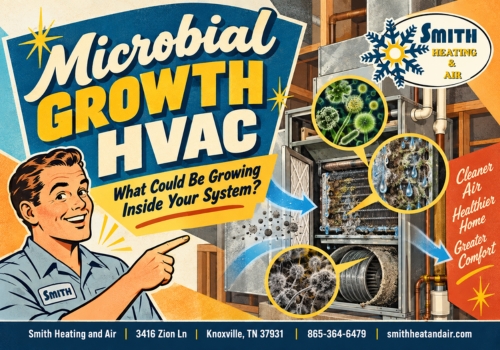
When homeowners think about indoor air quality, they often think about changing the air filter. However, the filter is only one part of the HVAC system. Moisture, condensation, dust, and debris can collect inside equipment where homeowners rarely look. Under the right conditions, these areas may develop HVAC microbial growth.
Finding microbial growth in HVAC equipment does not automatically mean that mold is present. Different types of microorganisms and buildup can look similar, and proper testing may be needed to identify exactly what is growing. Still, visible growth or heavy contamination inside the system is a reason to take a closer look at the condition of the equipment.
What Causes Microbial Growth in HVAC Systems?
A combination of moisture and organic material can create conditions where microorganisms may grow.
Your HVAC system regularly moves large amounts of air through the home. Along with that air come dust, pollen, pet dander, fibers, and other small particles. While filtration captures some of these materials, particles can still accumulate on internal surfaces.
Moisture can also be present.
During cooling operation, the evaporator coil becomes cold enough for water vapor in the air to condense. Normally, this moisture drains safely away through the condensate system. However, dirty components, drainage problems, excessive humidity, or restricted airflow may leave some areas damp for longer periods.
When moisture combines with accumulated dust and debris, conditions can become more favorable for microbial activity.
Where Can Microbial Growth Develop?
The inside of an HVAC system includes many surfaces that homeowners rarely see.
Growth or buildup may sometimes be found around:
- The evaporator coil
- Drain pans
- Blower components
- HVAC cabinet surfaces
- Insulation inside the cabinet
- Supply or return areas
- Duct connections
A dirty HVAC system may contain a combination of dust, debris, moisture, and biological material.
That is one reason technicians inspect more than the filter during HVAC maintenance. The condition of the equipment itself can provide important clues about airflow, moisture management, cleanliness, and overall system performance.
Why Isn’t Changing the Filter Enough?
Replacing a dirty filter is important, but it does not clean contamination that has already accumulated elsewhere.
A filter is designed to capture airborne particles as air passes through it. It cannot remove buildup that is already stuck to the blower wheel, coil, drain pan, cabinet, or other internal components.
For example, installing a new filter will not clean a layer of dirt that has collected inside the equipment over several years.
Likewise, if excess moisture is contributing to microbial growth HVAC problems, a new filter alone will not correct a clogged drain, humidity problem, dirty evaporator coil, or airflow restriction.
This is why indoor air quality should be considered from a whole-system perspective rather than focusing only on filter replacement.
How Does a Dirty HVAC System Affect Indoor Air Quality?
 Your HVAC equipment circulates air throughout the home many times each day. Therefore, the condition of the system can influence the cleanliness of that circulating air.
Heavy dust accumulation may reduce airflow or collect on important components. Moisture problems can create damp areas. Dirty coils and blower assemblies can also interfere with efficient HVAC operation.
In some homes, occupants may notice musty odors when the system starts. However, an odor alone cannot determine what type of contamination is present.
A professional inspection can help identify where buildup exists and whether moisture, filtration, drainage, or airflow problems may be contributing to the situation.
When Should HVAC Cabinet Cleaning Be Considered?
HVAC cabinet cleaning may be appropriate when an inspection reveals significant dust, debris, buildup, or microbial growth inside accessible areas of the equipment.
Cleaning should focus on the actual source of the problem rather than simply covering odors or treating surfaces without correcting the underlying conditions.
For example, technicians may also need to evaluate:
- Condensate drainage
- Indoor humidity
- Airflow
- Filter condition and fit
- Coil cleanliness
- Blower cleanliness
- Ductwork concerns
Simply cleaning a surface without addressing moisture or airflow problems may allow the same conditions to return.
Should Visible Growth Be Called Mold?
Not necessarily.
Homeowners and HVAC technicians may discover dark, light, fuzzy, spotted, or discolored material inside HVAC equipment. Although some growth may resemble mold, appearance alone is not always enough to identify it.
Testing may be necessary if determining the specific organism is important.
For that reason, terms such as “microbial growth,” “biological growth,” or “visible growth” are often more appropriate unless laboratory testing has confirmed exactly what is present.
Why Whole-System HVAC Maintenance Matters
Good indoor air quality involves more than installing a high-quality filter.
The HVAC cabinet, evaporator coil, blower, drainage system, ductwork, airflow, filtration, and humidity levels all work together. A problem in one area can affect other parts of the system.
Regular professional inspections allow Smith Heating and Air to look inside equipment that homeowners normally cannot see. If buildup, moisture, or unusual growth is discovered, the technician can recommend appropriate next steps and identify possible contributing conditions.
Frequently Asked Questions
What does microbial growth inside an HVAC system look like?
Microbial growth can appear as spotting, discoloration, films, fuzzy material, or other unusual buildup. Appearance alone cannot reliably identify the material as mold, so testing may be necessary for confirmation.
Can a dirty air filter cause microbial growth?
A dirty filter can restrict airflow and allow more debris to accumulate inside the system. However, microbial growth usually involves several contributing conditions, particularly moisture and available organic material.
Will changing my HVAC filter remove microbial growth?
No. A new filter helps capture future airborne particles, but it does not remove contamination already present on coils, blower components, drain pans, cabinet surfaces, or ductwork.
Why is there moisture inside my HVAC system?
Air-conditioning systems naturally create condensation as they remove heat and humidity from indoor air. Drainage problems, dirty coils, airflow restrictions, or high humidity can sometimes cause excess moisture to remain inside the equipment.
Should I have my HVAC system inspected if I see unusual growth?
Yes. An HVAC professional can inspect the equipment for buildup, moisture, drainage issues, dirty components, airflow problems, and other conditions that may be contributing to microbial growth. If identification of the material is required, specialized testing may also be recommended.
Smith Heating and Air can inspect your HVAC equipment and help determine whether dirt, moisture, filtration problems, airflow restrictions, or other system conditions may be affecting your home’s indoor air quality. Give us a call today!
See more heating and cooling on our Facebook page.
Smith Heating and Air
3416 Zion Ln
Knoxville, TN 37931
865-364-6479
https://smithheatandair.com/
Areas Served:
Knoxville, Fountain City, Farragut, Powell, Halls, Karns, Friendsville, Clinton, Concord, Kingston, Townsend, Greenback, Maryville, Oak Ridge, New Market, Kimberlin Heights, Corryton


0 Comments